
The short answer: sometimes it didn't. Our analytics showed Google-referred visits to a B2B job board we run falling from 312 one week to about 60 the next. That looks like a disaster. But 329 of those Google visits came on just two days, and Search Console showed almost none of them as real searches. Real Google search clicks actually went up, from 40 to 55 week over week.
The "drop" was a one-time spike ending. Here's how we found that, and the exact checks to run before you panic about your own traffic.
We run AI automation on our own businesses and publish what works, with real numbers. In this case, an AI agent did the digging across three analytics tools.
What we saw
The weekly report flagged it:
| Week | Google-referred visits (Fathom) |
|---|---|
| Week ending Oct 18 | 312 |
| Week ending Oct 25 | ~60 |
That's a drop of about 80%. Total visits to the site were down too, from 1,282 to 1,155 over the trailing seven days.
The usual panic list starts here: a Google update, a penalty, a broken page, a lost ranking. Before touching anything, we checked whether the traffic was real.
Step 1: Look at the days, not the week
Weekly totals hide spikes. The daily view told the story right away:
- Oct 11 and Oct 12 alone had 329 Google-referred visits (75 and 254).
- On most other days, Google sent a modest trickle: between 4 and 31 visits a day.
So the "312" week wasn't a normal week. It contained one huge two-day burst. Compared with any normal week, the following week was flat.
Step 2: Check Search Console, the source of truth for Google search
Analytics tools label a visit "Google" based on the referrer. Search Console counts actual clicks from Google Search results. If the two disagree badly, the analytics number is probably wrong.
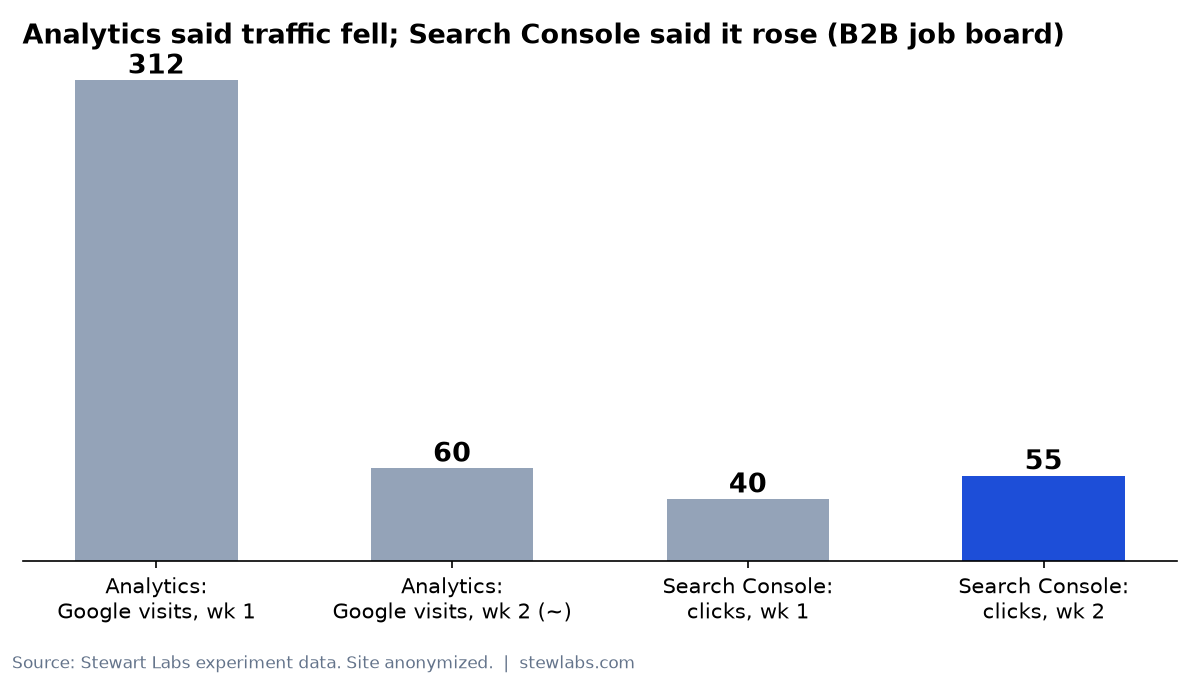
Analytics vs Search Console for the same weeks.
Here's what Search Console said for the same days:
| Day | Google-referred visits (Fathom) | Search clicks (Search Console) |
|---|---|---|
| Oct 11 | 75 | 3 |
| Oct 12 | 254 | 10 |
Hundreds of "Google" visits and a handful of real search clicks. Whatever that spike was, it wasn't people searching on Google.
Then the week-over-week comparison:
| Week | Search Console clicks |
|---|---|
| Oct 12–18 | 40 |
| Oct 19–25 | 55 |
Real search clicks rose 38%. The week our analytics called a crash was actually our better week in search.
Step 3: Wait for Search Console to finish counting
One trap: Search Console data for the last two or three days is incomplete. When we first ran this check on Oct 26, the Oct 19–25 week showed 48 clicks. When we pulled the same week again later, it showed 55. If you compare a fresh week to a finished one, the fresh week will always look worse than it is.
Rule of thumb: wait three days before comparing the most recent week, or compare weeks that ended at least three days ago.
Step 4: Count people, not visits
A third tool, PostHog, counts unique people. We filtered to people who arrived from Google Search:
| Week | Unique people from Google Search (PostHog) |
|---|---|
| Oct 12–18 | 78 |
| Oct 19–25 | 79 |
Flat. The same number of real humans found the site through Google both weeks.
Step 5: Look for bots
While we were in there, we found two other things inflating the numbers:
- A "direct" bot. About 1,065 "people" (already excluded by an existing filter) showed the same fingerprint: one old browser version on the same operating system, all at an unusual 800×600 screen size. Real visitors don't all look identical.
- Meta's link crawlers. When a link is shared on Facebook or Instagram, Meta's crawlers fetch the page, and some analytics tools count those fetches as visits. A filter we added on Oct 26 removed 715 of those crawler "people" in the first seven days.
Neither was caused by search, but both made the totals look bigger than reality, which makes any normal week look like a drop by comparison.
So why did my website traffic drop?
If your traffic dropped, work through this list before changing anything on the site:
- Was the previous period inflated? Look at daily data. A spike, a viral share or a bot run makes the next normal week look like a drop.
- Does Search Console agree? If Search Console clicks are flat or up, Google didn't penalize you. Your analytics labeling is off.
- Is the latest data complete? Search Console lags by a few days. Re-pull before you compare.
- Are you counting bots? Look for identical browsers, odd screen sizes and crawler user agents. Filter them out.
- Did something actually change? Only if Search Console clicks or rankings really fell should you look at Google updates, broken pages, redirects, robots.txt or lost backlinks.
How the AI agent helped
The whole investigation ran across three tools: Fathom for visits, Search Console for real search clicks and PostHog for unique people and bot detection. An AI agent with read-only access to all three:
- pulled daily data for both weeks from each tool
- lined the numbers up side by side
- spotted the two-day spike and the Search Console mismatch
- found the identical-fingerprint bot cluster
- wrote the filter that removes Meta's crawlers going forward
Nothing on the site was changed in a panic, and nothing needed to be.
What we changed
- A new bot filter for Meta's crawlers, alongside the existing one for the direct bot, so neither inflates totals.
- Search Console as the weekly source of truth for Google search, with analytics used for behavior on the site.
- A three-day buffer before comparing the latest week.
The takeaway
An "80% drop" in Google traffic turned out to be a 38% rise in real Google search clicks, hidden behind a two-day spike and some bots. Before you rewrite pages or chase an algorithm update, check whether the traffic you lost was ever real.