
The short answer: for a paid membership product, cheap Facebook leads were not worth it for us. A B2B job board we run spent $321.63 on Facebook lead forms over 30 days. That bought 73 leads, about $4.41 each. An AI voice agent called them automatically and reached 18 live people. Exactly 1 lead became a paying customer, on a $49 quarterly plan. That's a customer acquisition cost of about $322 for $49 of revenue.
The leads were cheap. The buyers weren't. Here's exactly what we ran, what the AI follow-up did and what we'd do instead.
We run AI automation on our own businesses and publish what works, with real numbers. Sometimes "what works" means knowing when to stop.
The setup
The product is a paid membership for job seekers (plans from $29 a month, or $49 for three months). The goal was simple: put a lead form in front of the right people, then let automation turn leads into members.
The campaign
- One lead-generation campaign, running Oct 13 to Oct 26.
- Four ad sets at $6.25 a day each, so $25 a day in total.
- Each ad set tested a different angle: a pay-focused control ad and three alternatives.
- Because it's a jobs offer, Facebook requires the Employment special ad category. That limits targeting options, so we used broad US targeting, ages 18 to 65, with Advantage+ audience on.
The form
An instant form asked which role the person wanted, their remote preference, consent to email and calls, and their contact details.
The automation
- A new lead lands in the CRM with a source tag.
- An AI voice agent calls them automatically, asks about their job search and offers to send matching jobs.
- If they don't answer, they get a text and a sequence of follow-up emails with live job counts.
- Anyone who wants to talk to a person gets a callback task.
On paper, it's the dream setup: leads come in, AI follows up instantly, and nobody has to dial.
What the ads did
The front of the funnel worked. In the first week (Oct 13 to 20), the campaign spent $208.44 for 4,930 impressions and 287 clicks. Click-through rates by angle:
| Ad angle | Spend (Oct 13–20) | CTR |
|---|---|---|
| Control (pay-focused headline) | $58.51 | 7.36% |
| Angle A | $39.53 | 6.59% |
| Angle B | $39.41 | 4.79% |
| Angle C | $37.58 | 3.92% |
The pay-focused control won. Concrete numbers beat clever copy. Over the full 30 days, the account produced 73 leads for $321.63.
If you stopped measuring here, you'd call it a success.
What the AI voice agent did
The voice agent called new leads automatically. Here's what it found, based on the call transcripts:
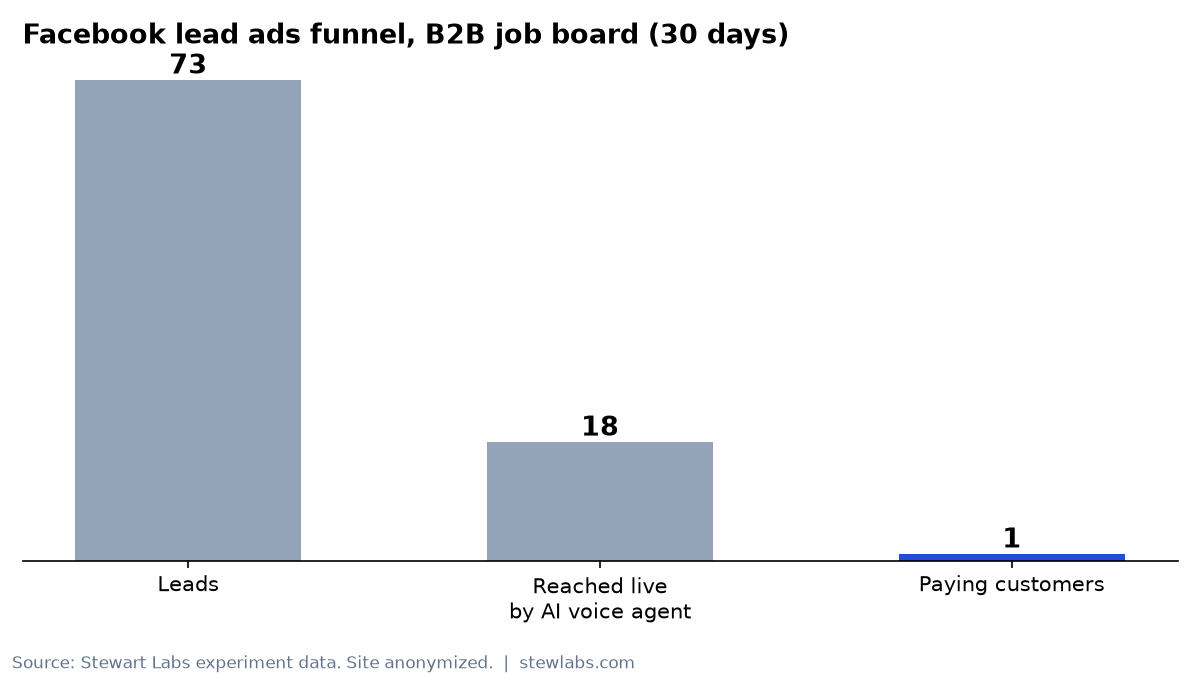
From 73 leads to 1 paying customer.
| Outcome | Count |
|---|---|
| Reached a live person | 18 |
| Full conversations | 16 |
| Brief pickups (callback request or "don't call") | 2 |
| Asked for a callback | 3 |
| Started checkout | 1 |
| Paid | 1 ($49, 3-month plan) |
Everyone else went to voicemail, didn't answer or had no mailbox set up.
The agent did its job. It called automatically, held real conversations, and handed off the people who wanted a human. The problem was further up. Most people filling out the form weren't looking to pay for a job board. Facebook makes it very easy to submit a form, since your name, email and phone are pre-filled. That's great for volume and bad for intent.
The callbacks show the other limit of automation. Two people asked to talk at a specific time, and the retries kept landing at the wrong time of day. A person with a calendar would have handled that better than a dialer on a fixed schedule.
The test that should have fixed it: price upfront
If the problem is low intent, the classic fix is to add friction. We built a second version of the form that:
- used Facebook's "higher intent" form type, which adds a review screen before submitting
- named the price on the intro screen (from $29 a month, or $49 for 3 months, with a 30-day refund)
- added one required question at the end: "This is a paid membership. Are you open to that?"
It launched with a smaller budget alongside the original. On Oct 24, it was the only ad set that produced leads: 2 leads for $5.75. The next day it spent $19.83 and produced 0. By then the campaign was a few days from its planned end, and there wasn't enough data to call the test either way.
The follow-up emails
The leads who didn't pick up went into an email sequence. Two follow-ups went to about 50 leads each, with real, current job counts in the body. They brought in no new customers. The only replies in that window were opt-outs, and we honored them right away.
The math
| Spend (30 days) | $321.63 |
| Leads | 73 |
| Cost per lead | ~$4.41 |
| Reached live by the AI agent | 18 |
| Paying customers | 1 |
| Revenue | $49 |
| Cost per customer | ~$322 |
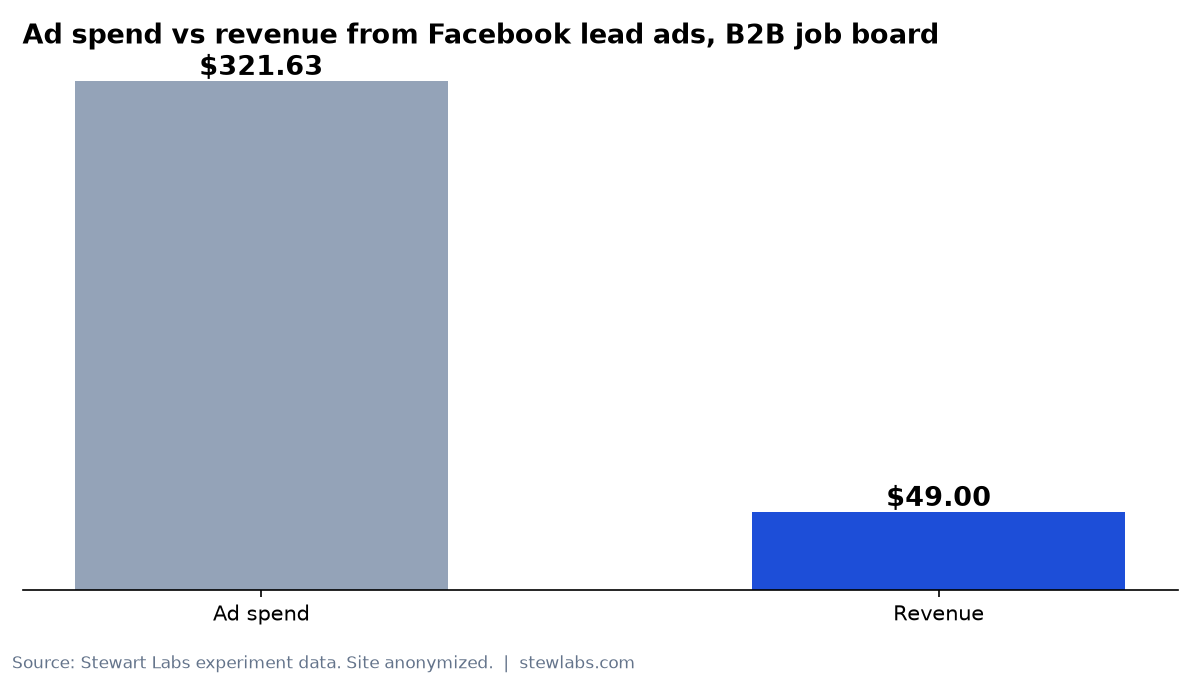
Spend vs revenue for the test.
Even with perfect AI follow-up, this would have needed something like a 6x jump in close rate just to break even on the first payment. We stopped the ads on Oct 26.
So, are Facebook lead ads worth it?
They can be, depending on what you sell. Here's how we'd think about it now:
Lead forms tend to work when:
- the next step is free (a quote, a consult, a demo)
- you sell a high-ticket service where one close pays for hundreds of leads
- a human calls within minutes and can book the next step
Lead forms tend to struggle when:
- you sell a low-price subscription
- the buyer needs to see the product before paying
- the form is so easy that curious people submit it on a whim
A $49 membership is firmly in the second group.
What we'd do instead
- Send ad clicks to a page, not a form. Someone who clicks through to a job board and sees real listings has shown more intent than someone who tapped "Submit" on a pre-filled form.
- Price upfront from day one. If you do use a form, make the price impossible to miss. Fewer, better leads beat 73 cheap ones.
- Measure cost per customer, not cost per lead. $4.41 a lead looked great. $322 a customer was the real number.
- Set a kill rule before you launch. Ours should have been something like "if we don't have 2 customers by $150, stop." Decide it before the money's spent, not after.
- Keep the AI follow-up, but add a human for callbacks. The voice agent was good at first contact. Scheduling a call at someone's preferred time is still easier for a person with a calendar.
The takeaway
The AI automation worked. Leads were called automatically, logged, tagged, texted and emailed with no one lifting a finger. But automation can't create intent that isn't there. If the offer and the channel don't match, faster follow-up just gets you to "no" sooner.